



Academic Year 2026-27
Class |
Details |
|
|---|---|---|
Toddler (Full Day) |
Age 18 mos – 3 years 8:00 AM – 3:00 PM $37,790 |
|
Toddler (Half Day) |
Age 3 and under only 8:00 AM – 11:30 AM $29,100 |
|
Children’s House (AM) |
Age 3 and under only 8:20 AM – 11:30 AM $21,850 |
|
Children’s House |
Age 2.9 years – 6 years 8:20 AM – 2:45 PM $28,360 |
|
Lower Elementary |
Grades 1 – 3 8:00 AM – 3:00 PM $29,150 |
|
Upper Elementary |
Grades 4 – 6 8:00 AM – 3:00 PM $30,400 |
|
Middle School |
Grades 7 – 8 8:00 AM – 3:00 PM $30,400 |
|
Early Before School Care |
Toddler through Middle School 7:00 AM – start of school day $4,350 |
|
Before School Care |
Toddler through Middle School After 7:30 AM – start of school day $2,200 |
|
After School Care |
Toddler through Middle School End of school day – 4:45 PM $5,225 |
Toddler
Ages 18 months – 2 years 9 months
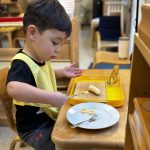
Our Toddler classroom offers a safe, structured, and beautiful indoor and outdoor spaces where young children can explore, move, and learn with confidence. Every child-sized material in the environment sparks curiosity and lays the foundation for later learning. Activities such as pouring, sorting, music, and art allow children to experience meaningful work that promotes problem-solving and emerging independence.
Children’s House
Ages 2 years 9 months – 6 years
In Children’s House, students begin to build a foundation of knowledge and independence through exploration and purposeful work. The prepared environment of child-sized materials and furniture in each classroom is designed to encourage self-discovery and a joy of learning while strengthening fine motor skills, focus, and concentration.
Students engage in individual, hands-on lessons throughout the day, choosing materials purposefully while working within a community of peers. Guided by their teachers in Grace and Courtesy, they learn to respect themselves and others, care for shared workspaces, communicate thoughtfully, and develop essential social skills. Within clear and consistent boundaries, children experience freedom within limits and build a strong sense of responsibility. These experiences nurture confidence, independence, and a strong foundation for success in the Elementary level.
Lower Elementary
Grades 1 through 3
Lower Elementary is a dynamic, hands-on learning environment where children’s ideas take shape. Through stories, exploration, and purposeful activities, students expand their imagination and develop strong intellectual abilities.
In a rich and all-encompassing academic environment, students move from hands-on exploration using concrete materials to increasingly abstract understanding and critical thinking. As with all Thacher programs, students work to their full potential, with readiness guiding each lesson they receive. They take genuine pleasure in choosing meaningful work, collaborating with peers, and engaging in conversations. At the same time, they are accountable for producing high-quality work across all areas of study.
Upper Elementary
Grades 4 through 6
Upper Elementary is a formative stage of development where students’ physical, social, and intellectual capabilities converge. With new needs and expanding abilities in grades four through six, learners are ready for deeper inquiry, greater independence, and increasingly sophisticated work.
In this curriculum-rich and engaging environment, students begin to think more abstractly and work with ideas at a higher level. They explore concepts with increasing autonomy, apply skills across subject areas, and build confidence through meaningful, self-directed work.
As they progress, learning naturally shifts from hands-on exploration to deeper analysis, reflection, and critical thinking—laying the foundation for advanced academics and responsible independence.
Middle School
Grades 7 and 8
Erdkinder: Montessori for Adolescence
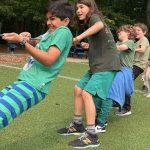
Maria Montessori envisioned a distinctive approach for adolescents, known as Erdkinder (“children of the earth”), recognizing this developmental stage as a time of rapid growth, identity formation, and a deep need for belonging and purpose. Rooted in meaningful work, real-world learning, and growing independence, Erdkinder environments help young people understand their place in the world and their ability to make an impact.
At Thacher, our Middle School program brings these principles to life through rigorous academics paired with hands-on experiences, community engagement, and leadership opportunities. It also aims to align with the Massachusetts State Curriculum Frameworks in key subject areas. Students are guided to think critically, collaborate thoughtfully, and take increasing responsibility for their learning as they prepare with confidence for high school and the world ahead.
Montessori Overview
Montessori education is a child-centered approach developed by Dr. Maria Montessori through her groundbreaking work observing how children learn best. Her insights have since been supported by more than a century of global practice and a growing body of research in child development and neuroscience. Studies consistently show that children thrive when they are trusted with choice, engaged in meaningful work, and supported in developing independence, collaboration, and critical thinking.
Montessori schools that follow recognized standards, such as those of the American Montessori Society (AMS) and Association Montessori Internationale (AMI), maintain essential elements that make the approach effective:
- Multi-age classrooms that nurture community, leadership, and peer learning
- 3-hour uninterrupted work cycle that builds focus and intrinsic motivation
- Purposeful Montessori materials that make learning hands-on and concept-driven
- Fully credentialed Montessori Educator who guides each child’s development with intention
- Intentionally Prepared Environment that encourages curiosity, responsibility, and independence
As a fully accredited Montessori school, Thacher Montessori School upholds these principles with fidelity in every classroom, serving students from Toddler through Middle School. Our students learn with joy, feel deeply connected to their community, and grow into capable, confident, and compassionate individuals.